
Blast Radius Analytics
The Complexity of Modern Distributed Microservices Modern banking, healthtech, and tax platforms are no longer monoliths. They are composed of hundreds of…
JobShout Article Writer5 min read
The Complexity of Modern Distributed Microservices
Modern banking, healthtech, and tax platforms are no longer monoliths. They are composed of hundreds of services spanning payments, identity, document processing, and LLM-assisted assistants.
Modern distributed microservice deployments generate massive volumes of heterogeneous, multi-format observability logs across physically and logically partitioned infrastructure [1]. In FinTech, a single funds transfer can touch an API gateway, fraud model service, ledger microservice, notification service, and a third-party KYC provider. In education and healthtech, a student record update or patient portal request can fan out to auth, audit, storage, and AI summarization services.
The partitioning is both logical and physical. Services run across availability zones and regions to meet compliance and latency requirements. That distribution is necessary for resilience, but it also fragments the signal an SRE needs when something goes wrong.
The Challenges of Root Cause Analysis
When latency spikes or error rates climb during tax filing season or a bank's end-of-month close, the first question is not what broke, but where the damage stops.
Isolating root causes during cascading failures remains an arduous task for Site Reliability Engineers (SREs), bottlenecked by manual keyword filtering and disjointed temporal correlation across monitoring dashboards [1]. In regulated industries this is compounded by constraints: audit logs must be retained, PHI and PII must be handled carefully, and any incident response must be explainable to auditors.
The manual approach forces engineers to hop between dashboards, correlate timestamps by eye, and guess blast radius. In banking, an overestimated blast radius can trigger unnecessary customer communications and regulatory notifications. An underestimated one can leave compromised data exposed.
For autonomous components, the problem deepens. The complexity and black-box nature of AI/ML have made rigorous testing a lot harder than it is in most software development [2]. Developers need reliable insights into how and why their models fail [2].
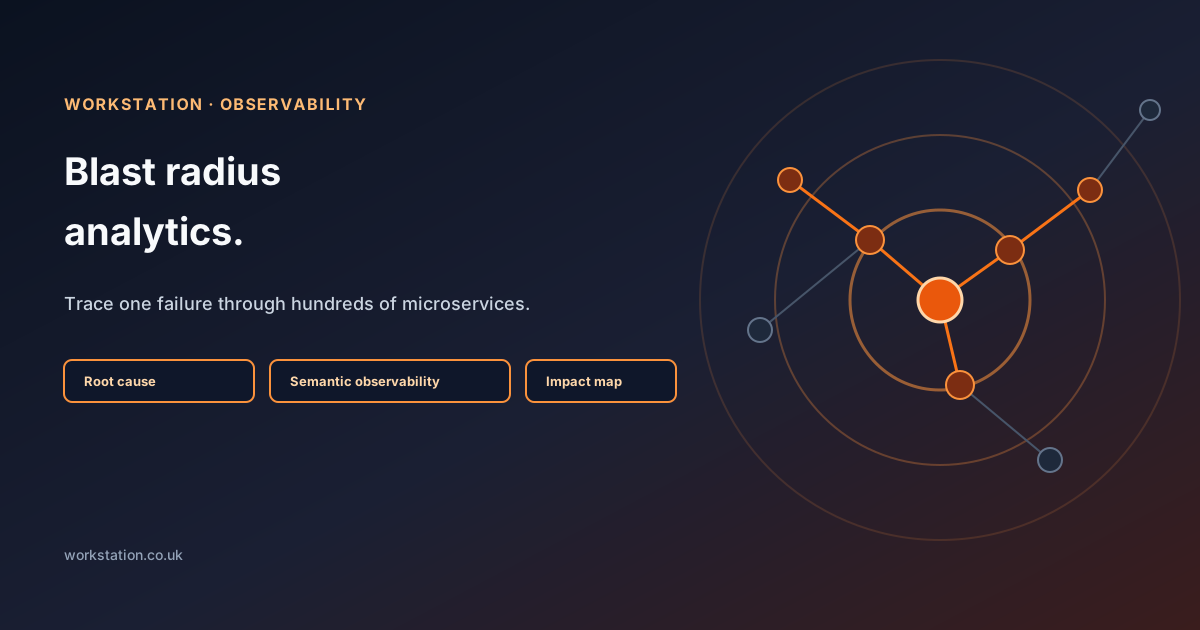
Blast radius is the set of services, data flows, customers, or tenants that are actually impacted by a fault, as opposed to the set that could be impacted. In autonomous systems, blast radius must be computable from the live dependency graph and recent telemetry, not inferred from alerts alone.
Semantic Observability: A New Approach
Semantic observability reframes logs and metrics as a knowledge graph rather than isolated streams.
Semantic Observability, an autonomous multi-agent framework, unifies disparate log streams into a dynamic, queryable Property Graph Database [1]. Instead of searching for keywords, the system builds a model of what is connected to what and when.
The system autonomously navigates the topology, applying causal graph algorithms and temporal back-traversal to isolate the precise blast radius of anomalies [1].
For a FinTech platform, this means the graph can express: payment service → fraud model v3 → feature store → S3 bucket, with edges annotated by request ID, latency, and error code. When the fraud model starts returning 5xx, temporal back-traversal can distinguish a local regression from a downstream feature store slowdown, and the graph can enumerate which customer flows are actually affected.
A simplified view of the data flow is illustrated below:
Figure 1: Semantic observability pipeline from raw telemetry through property graph to multi-agent reasoning and operator output.
The benefit for regulated domains is precision. Rather than declaring a broad incident, teams can state which products, customers, or data classes are impacted, and why.
Emerging Solutions: Resolve AI and Traceloop
Two current directions illustrate how semantic observability is being operationalized for blast radius analytics.
Resolve AI
Resolve AI automatically maps and keeps up-to-date a complete knowledge graph of any production environment, without needing any upfront training or user input [3]. That auto-discovery matters in banking and healthtech where environments change frequently due to compliance releases and model updates.
Resolve AI's goal is to automate the resolution of 80%+ of alerts and incidents without human involvement [3]. Its reasoning engine is composed of multiple agents, allowing it to investigate novel incidents, accurately determine causality, learn and adapt as it encounters new situations, and perform various complex actions [3].
For blast radius analytics, auto-discovered topology plus multi-agent reasoning enables containment statements such as “only e-filing submissions for a single state are affected,” which reduces unnecessary paging and regulatory notification.
Traceloop for LLM apps
As banks and educators add LLM assistants for chat support and document summarization, observability must extend to model behavior.
Traceloop is a monitoring platform that detects when your LLM app fails [4]. Under the hood, we built real-time versions of known metrics like faithfulness, relevancy, redundancy, and many others [4]. The project also promotes OpenLLMetry, an open-source package that standardizes the use of OpenTelemetry to observe LLM apps [4].
In healthtech, where an LLM summarises clinical notes, detecting a drop in faithfulness is as operationally important as a 500 error. The same blast radius concept applies: which patient cohorts received summaries from a degraded model version?
Trade-offs in current approaches
Comparison of approaches for blast radius determination
| Approach | Strength | Limitation |
|---|---|---|
| Keyword + dashboard correlation | Familiar tooling, low upfront cost | Manual, error-prone under cascading failures [1] |
| Semantic graph + multi-agent reasoning | Automated causality, precise blast radius [1] | Requires graph data model and agent ops |
| LLM-specific observability | Real-time metrics for faithfulness, relevancy, redundancy [4] | Needs standardized telemetry for LLM apps [4] |
Real-World Applications and Future Directions
In practice, blast radius analytics changes how SRE teams operate in regulated sectors.
For banking, a payment retry storm can be isolated to a specific card network integration without assuming all payments are affected. For education, a gradebook sync failure can be bounded to a single LMS tenant. For healthtech, a model drift event can be correlated to a specific data source update and limited to non-clinical features.
Limitations remain. Graph completeness depends on consistent instrumentation and request context propagation across physical and logical partitions. Causal inference is probabilistic and can be confounded by coincidental latency spikes. Agent reasoning adds operational overhead and must be auditable for regulated incidents.
Future work should focus on concrete capabilities: incremental graph updates for frequent compliance releases, explainable causal paths suitable for auditor review, and integration of model debugging signals with service-level blast radius so a degraded LLM version can be mapped to affected patient cohorts or document types.
Benefits of Blast Radius Analytics
The operational advantage is precision and reduced human toil. Precise blast radius limits customer impact, constrains regulatory exposure, and focuses remediation on the actual fault boundary. Automated causality reduces manual dashboard hopping during cascading failures, and a queryable property graph provides an explainable record for post-incident review.
For developers in banking, education, healthtech, FinTech and tax returns, the takeaway is consistent: blast radius is not a marketing term, it is an operational property. With semantic observability, the blast radius becomes computable, not guessed. That precision reduces customer impact, limits regulatory exposure, and lets SRE teams focus human attention on the incidents that truly require it.
References
- Semantic Observability for Autonomous Systems Diagnostics — arxiv.org
- Launch HN: Openlayer (YC S21) – Testing and Evaluation for AI — news.ycombinator.com (5 December 2023)
- Show HN: Resolve AI – Your AI Production Engineer | Hacker News — news.ycombinator.com (1 October 2024)
- Launch HN: Traceloop (YC W23) – Detecting LLM Hallucinations with OpenTelemetry — news.ycombinator.com (17 July 2024)